Many buyers think a defect check simply means looking for:
Cracked walls.
Peeling paint.
Misaligned doors and windows.
Broken tiles.
These are important.
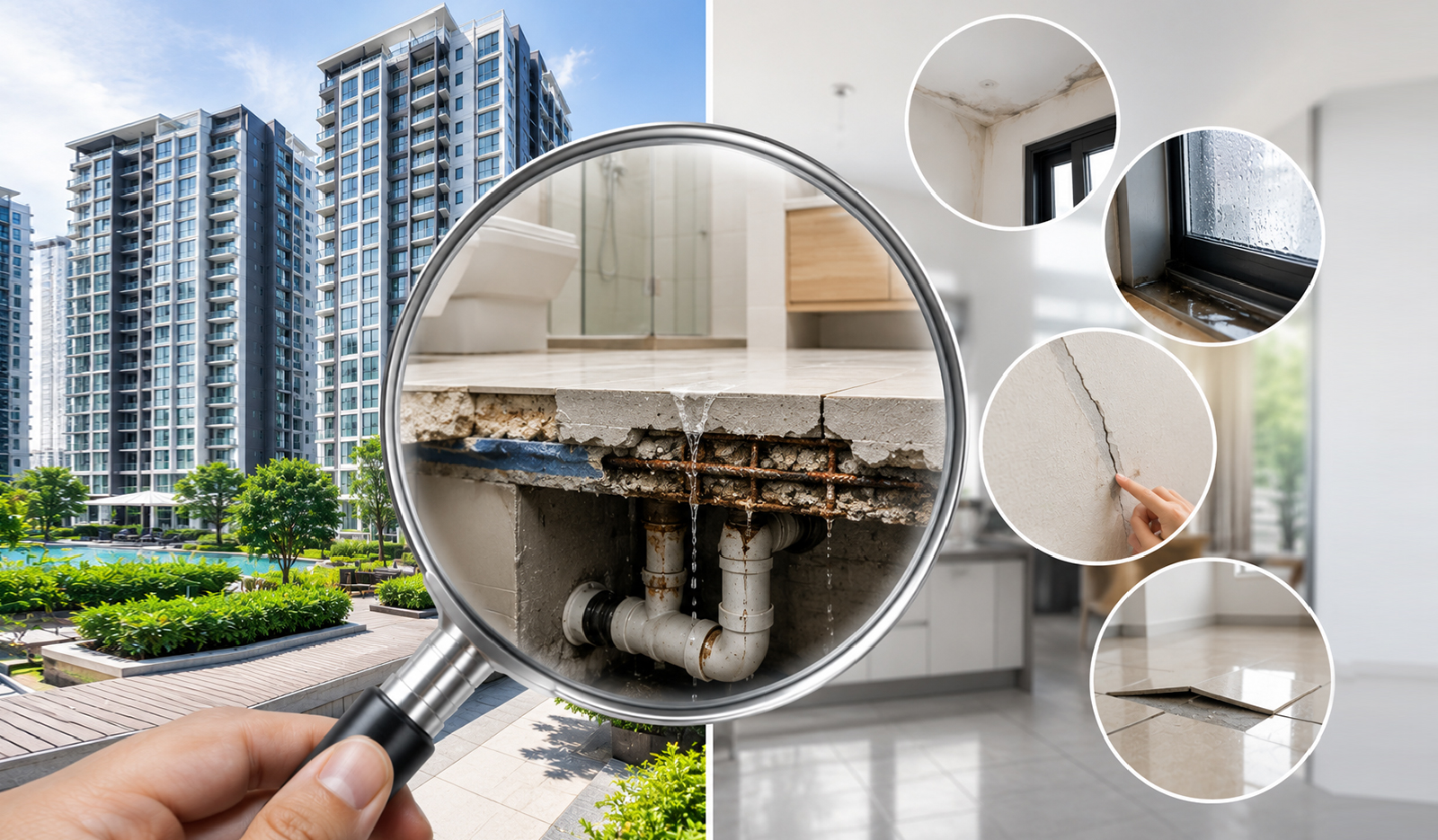
But the defects that usually cost homeowners the most are not always the ones you can see on handover day.
The real danger is hidden defects.
They may look invisible at first, only to slowly appear after you have moved in, renovated, or started using the unit daily.
The worst part?
By the time the problem becomes obvious, the Defect Liability Period, or DLP, may already be over.
Once that happens, repair responsibility may become more complicated, and the homeowner may need to bear the cost personally.
The Most Expensive Defects Are Often Not the Ones You See First
Most handover defects are surface-level issues:
Uneven paint
Minor wall cracks
Scratched tiles
Loose sockets
Misaligned doors
Poor finishing
These are annoying, but they can usually be reported during the DLP for the developer to follow up.
The more serious problems are often hidden inside:
Under the tiles
Behind the walls
Inside the plumbing system
Inside the wiring system
Under the waterproofing layer
Within drainage slopes
Through sound transmission in the building structure
They do not show themselves on the first day.
But once they appear, the repair can be expensive and disruptive.
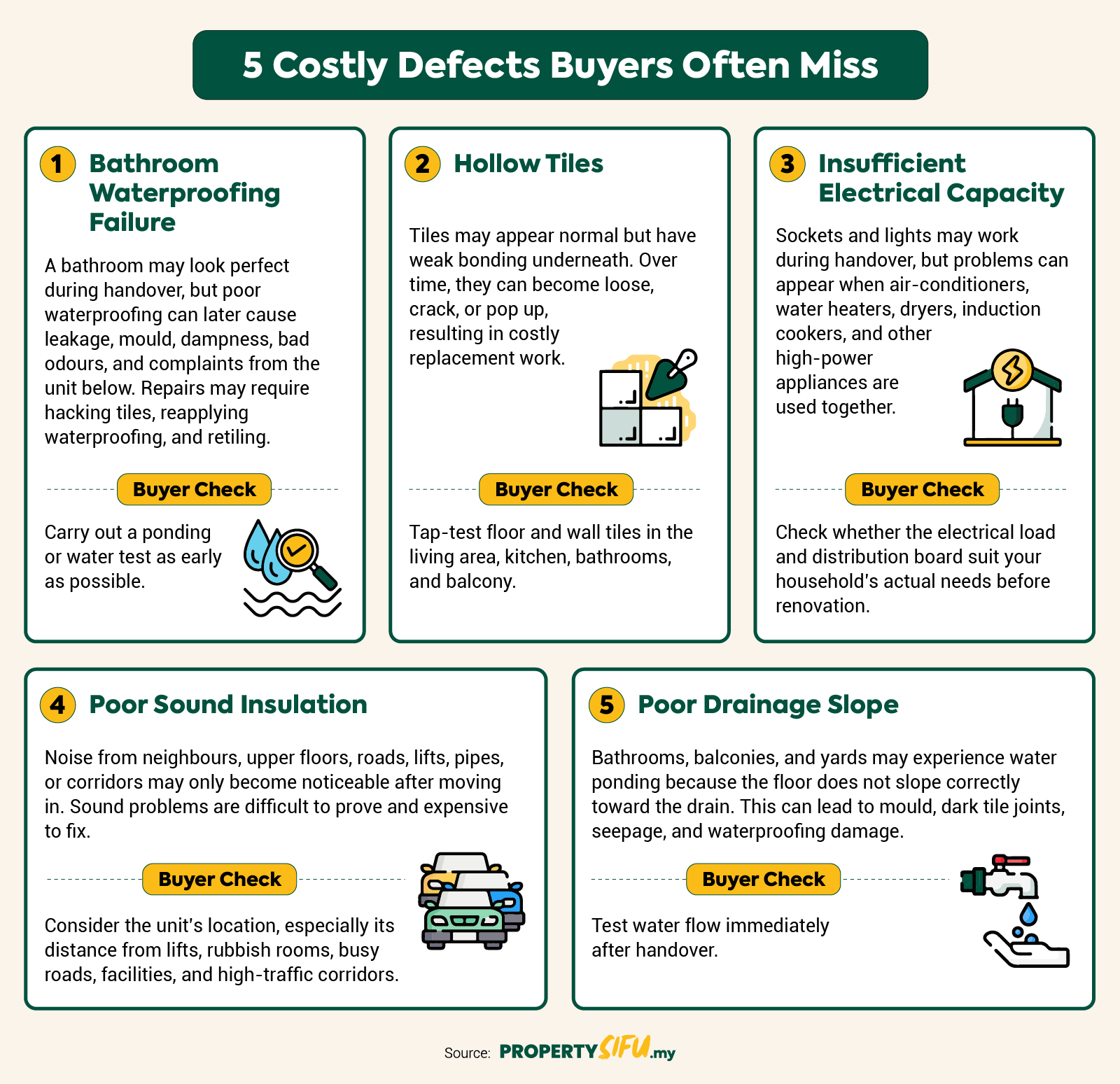
5 Hidden Defects Buyers Often Miss — But May Cost a Lot Later
1. Bathroom waterproofing failure
This is one of the most painful issues for condo and landed homeowners.
At handover, the bathroom may look perfect.
The tiles are new, the fittings look clean, and everything seems fine.
But after some time, signs may start to appear:
This may be caused by poor waterproofing work or incomplete treatment around certain areas.
The problem is rarely solved by simply applying silicone.
In many cases, repair may require:
If the DLP has ended, the cost may fall on the homeowner.
Buyer check:
Do not only look at whether the bathroom looks nice. Do a ponding test or water test as early as possible after handover, and report any issue during the DLP.
2. Hollow tiles that only become obvious later
Many buyers only check whether tiles are cracked or scratched.
But one issue that is easy to miss is hollow tiles.
This happens when the tile is not properly bonded underneath.
The surface may look fine, but when tapped, it gives a hollow sound.
At first, it may affect only a few tiles.
Over time, you may notice:
This is often related to workmanship, cement mixture, or poor surface preparation.
If it is not detected during the DLP, repairs later may involve hacking, relaying, and matching tiles, which can be costly and messy.
Buyer check:
Do not inspect tiles with your eyes only. Tap-test floor and wall tiles area by area, especially in the living hall, kitchen, bathroom, and balcony.
3. Electrical load that is not enough for real daily use
This is something many buyers never think about during handover.
The lights turn on.
The sockets work.
So everything looks fine.
But after moving in, the real usage begins:
Air-conditioners
Water heaters
Dryer
Induction cooker
Large fridge
Computers
Smart home devices
Then problems may appear:
Frequent power trips
Hot sockets
Overloaded distribution board
Some appliances cannot be used together
Difficulty adding extra air-conditioners
Rewiring needed after renovation
This may not mean something is “broken”.
Sometimes the original electrical design only covers basic usage and does not match the household’s real lifestyle needs.
Fixing it later can involve rewiring, upgrading the DB box, hacking walls, and damaging completed renovation.
Buyer check:
Before buying or renovating, check whether the electrical capacity suits your lifestyle, especially if you have a bigger household, home office setup, or many high-power appliances.
4. Poor sound insulation
Sound insulation is one of the hardest problems to fix.
During handover, it is difficult to test real-life noise.
But after moving in, buyers may discover:
Footsteps from upstairs
Neighbour conversations
TV noise from next door
Corridor noise
Road noise affecting sleep
Pipe, lift, or door noise
These problems may be related to floor slabs, walls, windows, pipe design, or overall construction quality.
The difficult part is:
Noise issues are hard to prove and hard to fully solve.
Unlike cracks or leakage, noise is experience-based.
It may be difficult to get the developer to accept responsibility or provide a complete solution.
For own stay buyers, poor sound insulation can affect sleep, mood, and quality of life.
For investors, it may affect tenant retention.
Buyer check:
Do not only look at the view and interior design. Check the unit position too. Units near lifts, rubbish rooms, main roads, facilities floors, or high-traffic corridors may carry higher noise risk.
5. Poor drainage slope and long-term water ponding
Drainage issues are often underestimated.
At handover, the balcony, bathroom, or yard may look normal.
But after actual water use, you may notice:
Water does not flow properly to the drain
Balcony water stays for too long
Bathroom floor dries very slowly
Corners remain damp
Tile joints turn dark
Mould appears
Long-term seepage risk increases
This is usually related to floor slope.
If the slope is wrong, water will not naturally flow toward the drain outlet.
In the short term, it is inconvenient.
In the long term, it can cause mould, waterproofing stress, leakage, and tile problems.
Repair may require re-sloping, hacking tiles, or redoing the surface.
Buyer check:
After handover, test water flow in the bathroom, balcony, and yard as early as possible. Do not wait until months later to discover drainage problems.
Why Are These Problems So Hard to Notice Before Buying?
Because many hidden defects are not visible from brochures, show units, or normal viewings.
Buyers only see the finished surface:
Nice tiles.
Clean walls.
New doors and windows.
A neat kitchen.
Modern design.
But what determines long-term durability is often hidden behind the finishing:
Was the waterproofing done properly?
Were the tiles laid correctly?
Is the drainage slope accurate?
Is the electrical capacity enough?
Is the sound insulation acceptable?
Are the pipes and wiring properly planned?
These are not things an ordinary buyer can fully judge just by walking around the unit.
That is why many buyers only realise after moving in:
The expensive problems are not always at the buying stage. They may appear later as repair risks.
During DLP, the Key Is Not Just Waiting for the Developer to Fix Things
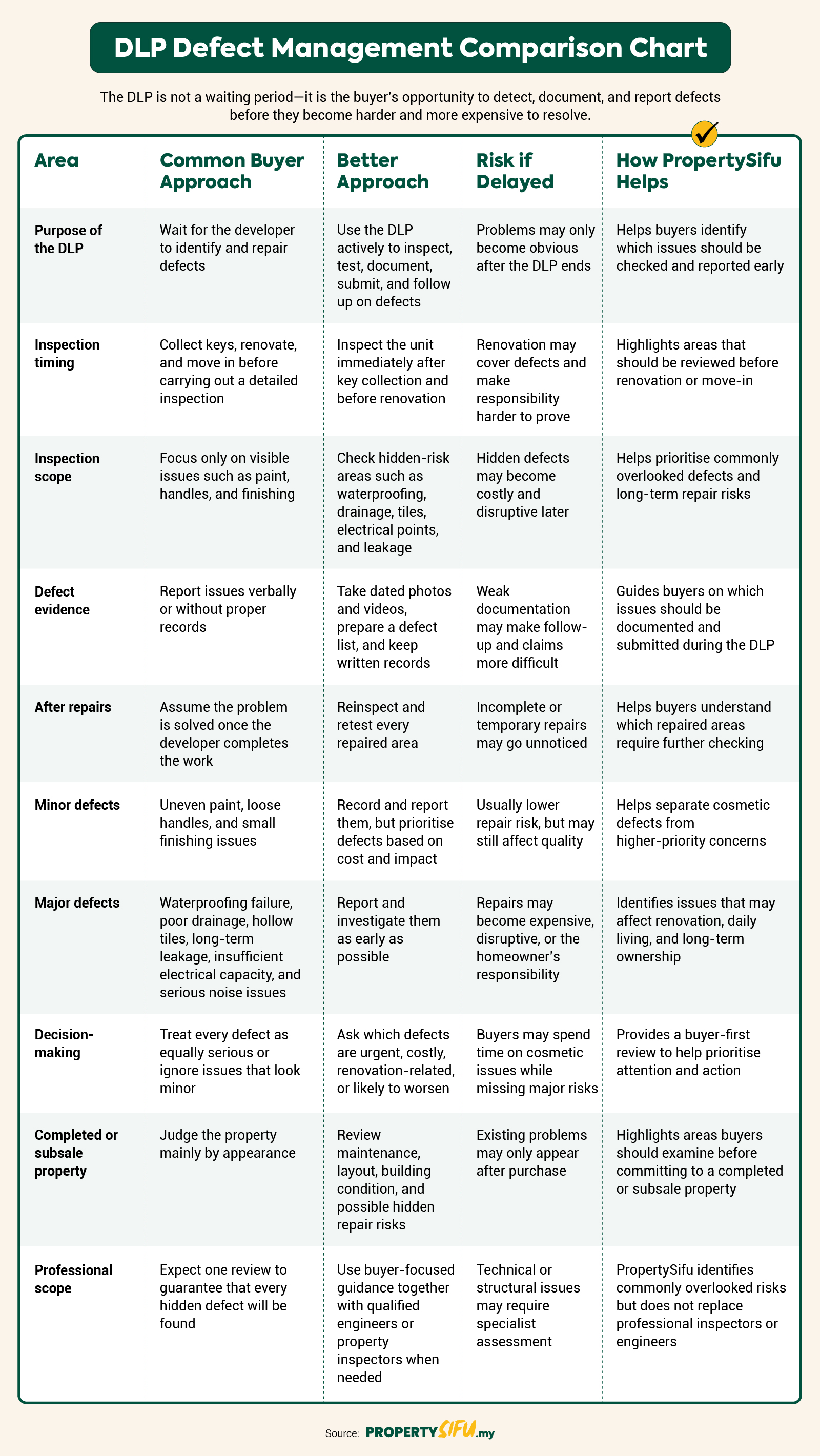
The DLP is not just a waiting period.
It is a time window for buyers to identify, record, and submit defects as early as possible.
Many buyers make the same mistake:
They collect the keys.
They do not inspect carefully.
They renovate first.
They move in first.
They only react when the issue becomes serious.
But once renovation is completed, some defects may be covered up.
When the problem appears later, it may be harder to prove, harder to repair, and more expensive.
Buyers should:
Inspect the unit as soon as keys are collected
Check beyond surface-level defects
Test waterproofing, drainage, tiles, and electrical points
Take photos and videos
Record dates clearly
Submit the defect list within the DLP
Follow up with the developer
Recheck after repairs are done
The earlier you detect the issue, the better your chance of reducing long-term cost.
The Biggest Problem Is Not That the Property Has Defects
New projects having defects is not unusual.
The real problem is:
You do not know which defects are minor, and which ones may become expensive later.
Minor defects may include:
Uneven paint.
Loose handles.
Small finishing issues.
Major concerns may include:
Waterproofing failure.
Poor drainage.
Insufficient electrical capacity.
Hollow tiles.
Long-term leakage.
Serious noise problems.
Buyers do not need to panic.
But they do need to know priorities:
Which defects must be reported immediately?
Which ones should the developer fix during the DLP?
Which ones may affect renovation?
Which ones may become expensive later?
Which ones could become your own cost if you miss the DLP window?
That is what buyers need to understand clearly.
How PropertySifu Can Help
PropertySifu does not only look at whether a property looks nice.
We look at a more important question:
Will this property create unnecessary repair risk for you in the next few years?
If you are about to receive keys, have just received keys, are still within the DLP, or are planning to buy a completed property, PropertySifu can help you review from a buyer-first angle:
Which defects should be prioritised
Which issues may affect long-term living
Which defects should be submitted during the DLP
Which areas should be water-tested or drainage-tested
Whether the layout, maintenance, and building condition suit long-term holding
Whether there may be hidden repair risks before buying
What to pay attention to when buying a subsale property
We cannot guarantee that every hidden defect will be found.
We also do not replace professional engineers or property inspectors.
But we can help buyers identify the commonly overlooked risks first, so you know which issues should not be delayed.
Conclusion: Buying a Home Is Not Only About Handover Day
Many property problems do not appear immediately during handover.
They slowly show up after you move in, after renovation, or when the DLP is almost over.
So do not only ask:
“Does this unit look nice?”
“Are there any wall cracks?”
“Are the doors and windows working?”
Ask this instead:
Does this property have hidden repair risks?
The biggest risk is not discovering defects.
The real risk is discovering them too late, after the best time to act has passed.
If you are about to receive keys, still within the DLP, or planning to buy a completed property, WhatsApp PropertySifu and send:
“Defect Risk Assessment”
We can help you check which issues should be prioritised, which defects should not be delayed, and how to reduce risk before small problems become long-term burdens.