How a normal tenancy can turn into a RM200,000 electricity risk
Many landlords think the biggest rental risks are:
Late rental payments, damaged furniture, early termination, or tenants refusing to move out.
But in recent years, some Malaysian landlords have faced an even more serious problem:
Their property was secretly used for illegal cryptocurrency mining.
At first, the tenant may look completely normal.
They pay the deposit.
They pay rent on time.
The unit does not look badly damaged.
They may even rent under a company name and say the unit is used for IT, servers, storage, or office purposes.
Then, a few months later, the tenant disappears.
The landlord may think the worst-case scenario is losing a few months of rental.
But instead, they may receive a large recovery notice from TNB.
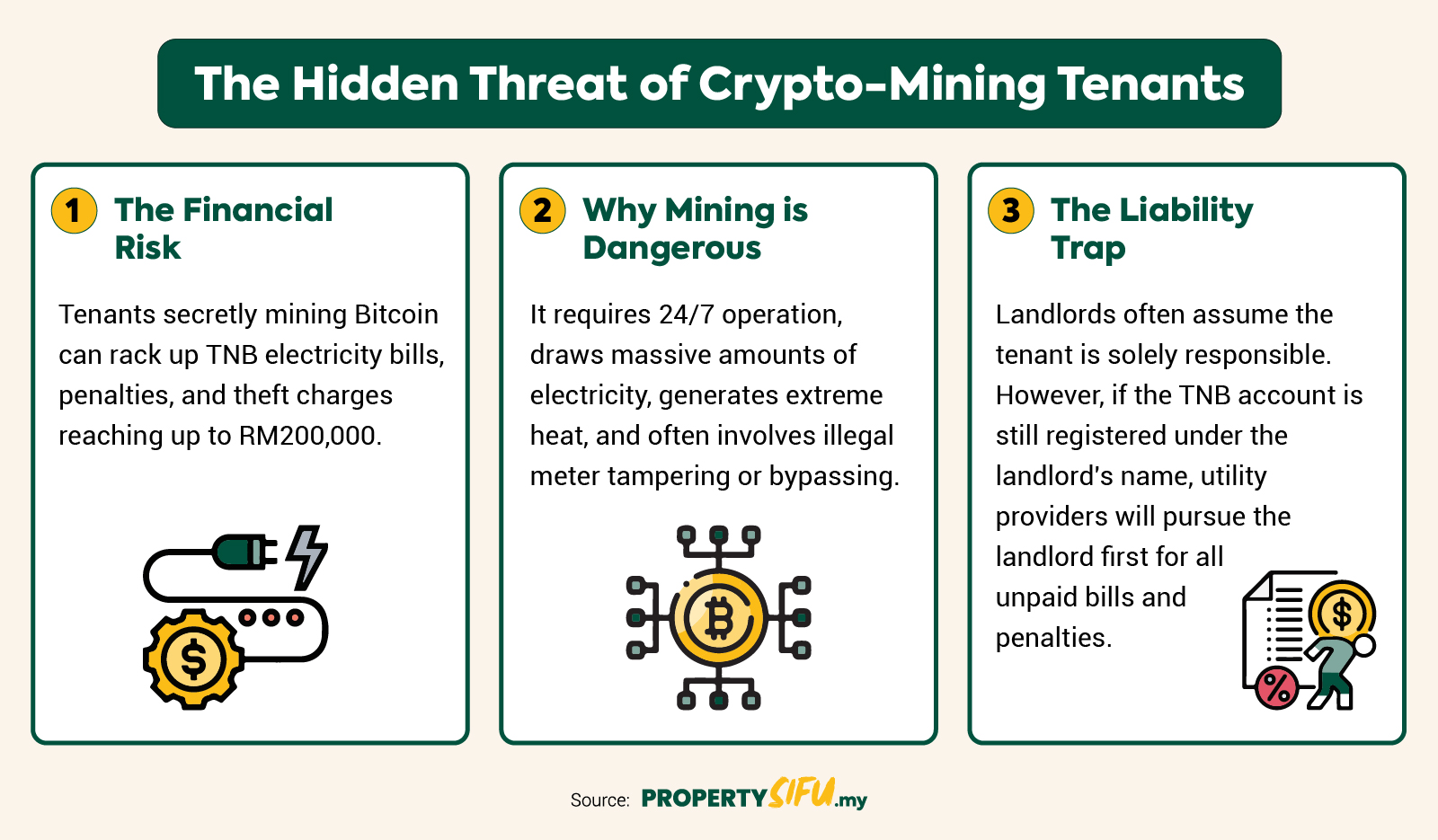
The electricity bill, penalties, investigation charges, and other recovery amounts can add up to tens of thousands of ringgit. In serious cases, the landlord may face a risk close to RM200,000.
The scariest part is this:
Even if the landlord did not use the electricity, if the electricity account is still under the landlord’s name, the landlord may be pursued first.
This is one rental risk many landlords do not realise until it is too late.
Why are bitcoin mining tenants so dangerous?
A normal tenant usually uses electricity for air-conditioning, fridge, water heater, washing machine, and normal household appliances.
Cryptocurrency mining is completely different.
Mining equipment usually involves:
24-hour operation
Heavy electricity usage
High heat generation
Multiple machines running at the same time
Possible electrical modification
Possible meter bypassing or electricity theft
For landlords, the danger is not just a high electricity bill.
The bigger risk is:
Once illegal electricity usage or meter tampering is involved, the issue may turn from a tenancy problem into a legal and financial recovery problem.
By the time many landlords find out, it is already too late.
Common landlord misconception: “I didn’t use the electricity, why should I be responsible?”
Many landlords will naturally think:
“The tenant used the electricity. It has nothing to do with me.”
This sounds reasonable, but in practice, the situation may not be so simple.
In many cases, the utility provider will first look at:
Whose name is registered under the electricity account?
If the TNB account is still under the landlord’s name, even if the tenant was the actual user, the landlord may still become the first party pursued for payment.
This is why many landlords only realise after the incident:
Even if the tenancy agreement is complete,
if the utility account was never transferred,
the risk may still come back to the landlord.
Of course, actual responsibility depends on the case, evidence, agreement, account registration, and relevant procedures. If this happens, landlords should seek proper legal advice as soon as possible.
But from a risk management perspective, landlords should not wait until something goes wrong.
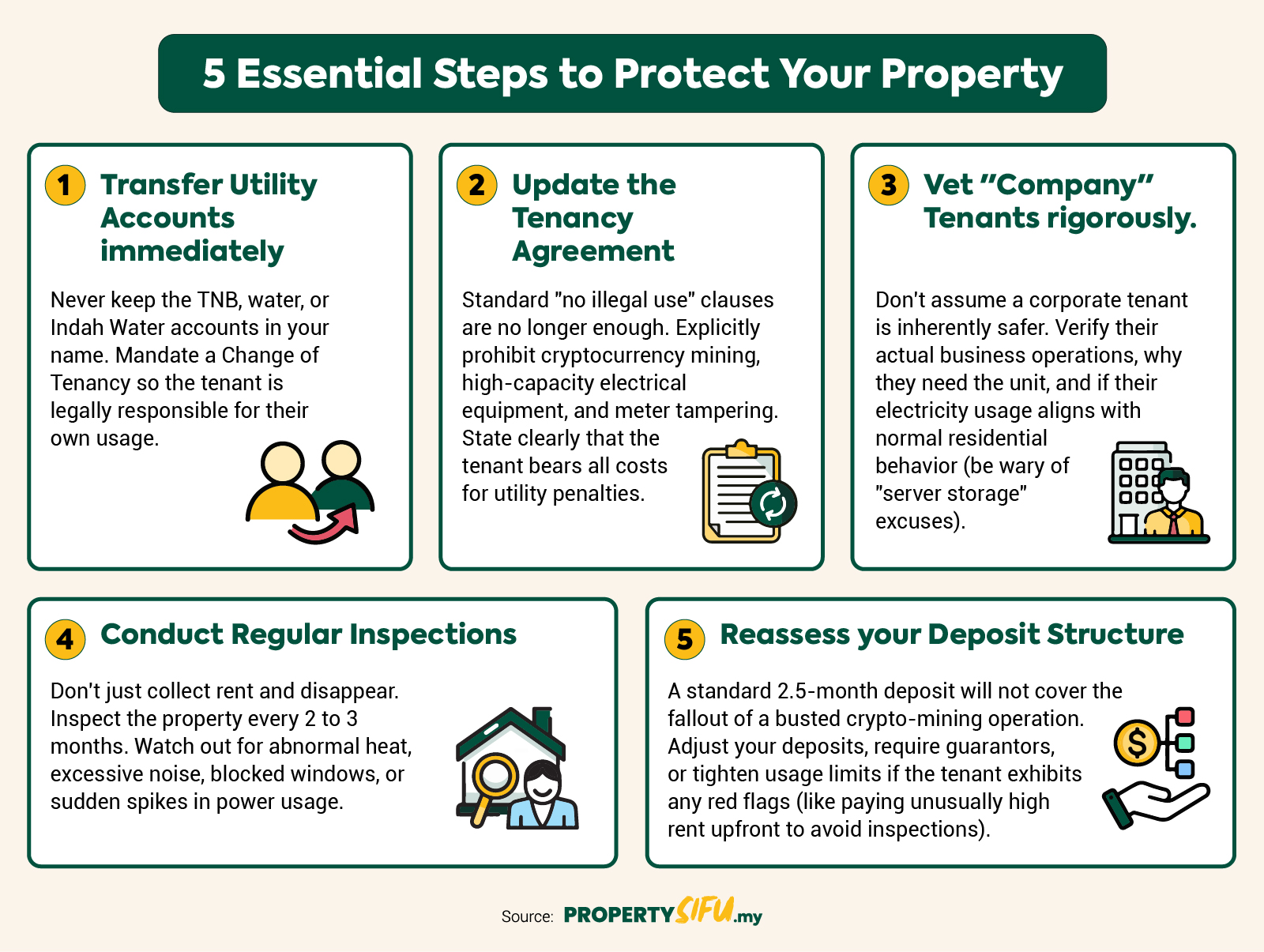
5 Minimum Risk Controls Landlords Should Put in Place
1. Always complete Change of Tenancy
This is one of the most important steps.
After renting out a property, landlords should arrange the transfer of:
The goal is to transfer the accounts to the tenant’s name as much as possible.
Why?
Because if the utility account remains under the landlord’s name, and the tenant uses excessive electricity, fails to pay, or gets involved in illegal electricity usage, the landlord may be dragged into the issue.
PropertySifu’s advice:
Do not only collect deposit and sign the tenancy agreement. Utility account transfer should be a necessary part of the rental process.
2. Your tenancy agreement must clearly prohibit mining and illegal electricity usage
Many normal tenancy agreements only say:
No illegal use.
No damage to the property.
No subletting.
But rental risks have become more complex.
Landlords should include clear clauses such as:
No cryptocurrency mining activities
No installation of high-electricity equipment
No modification of wiring or electricity meter
No illegal electricity connection, electricity theft, or meter bypassing
If discovered, the landlord has the right to terminate the tenancy
All penalties, recovery claims, repairs, and losses must be borne by the tenant
Vague clauses may not protect the landlord enough.
This is especially important if you are renting out a condo, landed property, shop lot, or semi-commercial property.
3. Do not assume a “company tenant” is automatically safer
Many landlords think:
“If a company rents the unit, it should be safer.”
Not always.
Some high-risk tenants may use a company name to rent the property, making the landlord less alert.
At minimum, landlords should check:
Whether the company actually exists
What the business really does
Why they need to rent this property
Whether they will install servers, machines, or special equipment
Whether electricity usage will be higher than normal residential usage
Whether employees will be entering and leaving regularly
Whether the use complies with condo or building management rules
If the tenant cannot clearly explain the usage and only says:
“We do IT.”
“It’s just for servers.”
“Nobody will stay there, it’s only storage.”
“It’s simple company use.”
Landlords should be extra careful.
4. Inspect the property regularly. Do not fully let go.
Many landlords stop monitoring the property once the tenant moves in, as long as rent is paid every month.
But illegal mining can stay hidden for a period of time.
Landlords should arrange regular inspections, for example once every 2 to 3 months, and watch out for:
Sudden abnormal electricity usage
Large number of machines inside the unit
Unusual noise
Excessive heat
Additional wiring or signs of electrical modification
Windows constantly covered or blocked
Tenant refusing inspection
Complaints from neighbours about noise or heat
Inspection is not about disturbing the tenant.
It is about protecting your asset.
Of course, landlords should provide proper notice before inspection according to the tenancy agreement to avoid disputes.
5. Do not look at deposit only from a rental amount perspective
Many landlords collect:
2 months rental deposit + 0.5 month utility deposit.
But if the tenant is involved in mining or illegal electricity usage, this deposit may not be enough to cover the loss.
Landlords should review the risk based on tenant type and property usage:
Is the utility deposit enough?
Is the tenant background reliable?
Is a guarantor needed?
Are extra documents needed?
Should the permitted usage be more clearly limited?
Should inspections be more frequent?
Be especially careful if the tenant requests:
No one staying in the unit
Equipment to be placed inside
Rental under a company name
No regular landlord inspection
Willingness to pay unusually high rent upfront
These situations should raise red flags.
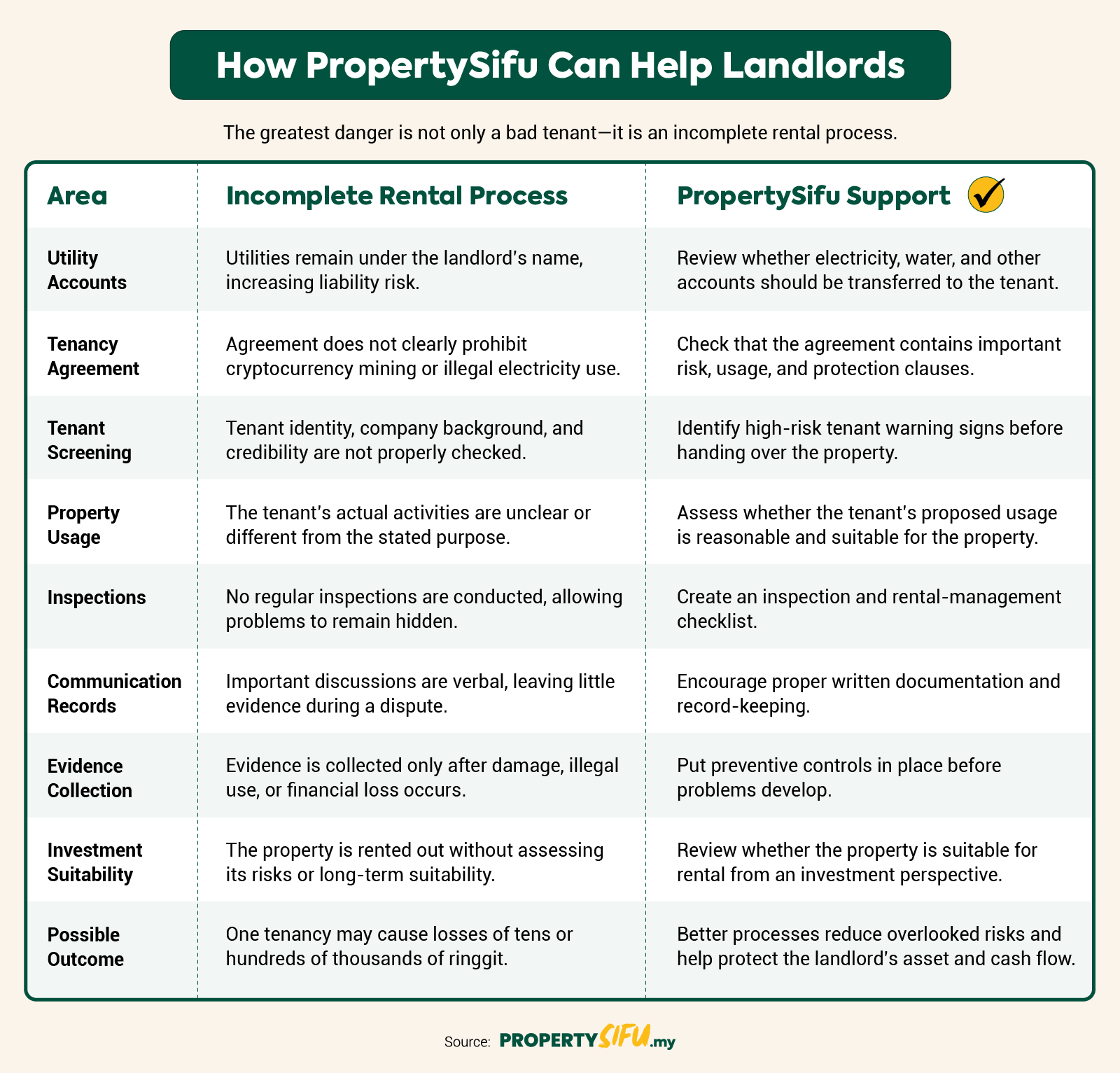
The biggest danger is not just a bad tenant. It is having no process.
Many rental problems happen not because the landlord did nothing.
They happen because the rental process was incomplete.
Common loopholes include:
Utilities were not transferred
Agreement did not prohibit mining
Tenant background was not checked
Actual usage was not confirmed
No regular inspection
No written communication records
Evidence was only collected after problems happened
Renting out a property does not end when you hand over the keys.
It is an asset management process.
If managed well, rental becomes cash flow.
If managed poorly, one tenancy can become a financial risk worth tens of thousands or even hundreds of thousands of ringgit.
How PropertySifu Can Help Landlords
PropertySifu does not only help buyers review projects.
We can also help landlords and investors identify rental risks before problems happen.
If you are preparing to rent out your property, or already have a tenant, we can help you review:
Whether your rental process is complete
Whether utility accounts should be transferred
Whether the tenancy agreement has key risk clauses
Whether the tenant’s stated usage makes sense
High-risk tenant warning signs
Rental checklist before handing over keys
Whether your property is suitable for rental from an investment perspective
We cannot guarantee that all risks can be fully avoided.
But we can help you spot the most commonly overlooked loopholes before they become expensive problems.
Before Renting Out Your Property, Ask Yourself These 7 Questions
Have the TNB and water accounts been transferred to the tenant’s name?
Does the tenancy agreement clearly prohibit mining and illegal electricity usage?
Have you checked the tenant’s identity and real usage?
Does the company tenant’s business nature make sense?
Have you arranged regular inspections?
Is the utility deposit enough for the risk level?
If the tenant disappears, do you have enough documents to protect yourself?
If you cannot answer these questions, do not rush to hand over the keys.
Conclusion: Rental Property Is Not Passive Income. It Is Active Risk Management.
Not every landlord will encounter a bitcoin mining tenant.
But if it happens, the loss can be serious.
For landlords, the most important thing is not to start looking for help only after the problem happens.
It is to reduce the risk before handing over the property.
Do not only look at whether the tenant is willing to pay rent.
Do not only look at how high the rental is.
What you really need to check is:
Will this tenant, this usage, this tenancy agreement, and this utility arrangement expose you to unnecessary risk?
If you are currently renting out your property, preparing to rent it out, or want to check whether your existing tenancy has loopholes, WhatsApp PropertySifu and send:
“Mining Risk Assessment”
We will help you review your rental process, utility transfer, tenancy risk, and tenant usage, so you can build a stronger first layer of protection before problems happen.