RM3,500 Monthly Mortgage vs Renting + Investing: What Could Happen After 10 Years?
Many Malaysian buyers grew up hearing this idea:
“Renting is just helping someone else pay their mortgage. Buying a home means building your own asset.”
It sounds reasonable.
But when you actually run the numbers, the answer is not always that simple.
Buying is not always better.
Renting is not always a waste of money.
The real question is:
If you have RM3,500 every month, should you use it to pay a mortgage, or rent and invest the difference? After 10 years, how different would your net worth be?
Let’s use a simple model
To make the comparison easier, let’s look at two options.
Option A: Buy a property
Property price: RM800,000
Down payment: 10% = RM80,000
Loan amount: RM720,000
Monthly instalment: around RM3,500
Loan tenure: 30 years
Interest rate: around 4%
Assumed property appreciation: 5% per year
Holding period: 10 years
Option B: Rent + invest
No property purchase
Monthly rent: RM2,500
The RM80,000 down payment is invested instead
The monthly RM1,000 difference is also invested
Assumed investment return: 7% per year
Investment period: 10 years
This is a simplified model to understand the trend. In real life, you still need to factor in interest rates, property appreciation, rental increases, maintenance fees, renovation, taxes, transaction costs, and personal cash flow.
After 10 years, what happens?
Option A: Buying a RM800,000 property
If the property appreciates by 5% per year, after 10 years:
RM800,000 × 1.05¹? ? RM1,302,000
That means the property value may grow to around RM1.3 million.
But the property is not fully paid off yet.
After paying a 30-year loan for 10 years, the remaining loan balance may still be around RM580,000.
So your estimated property equity is:
RM1,302,000 - RM580,000 = around RM722,000
That looks attractive.
But buyers often forget the additional costs of owning a property:
Maintenance fee
Sinking fund
Quit rent / assessment
Insurance
Renovation cost
Furniture and appliance depreciation
Repair cost
Legal fees, agent fees, RPGT, and other possible transaction costs
If these costs add up to RM50,000 to RM100,000 over 10 years, your actual net gain will be lower.
So buying is not just about asking:
“How much will the property be worth in 10 years?”
The better question is:
“After deducting loan balance and holding costs, how much do I really keep?”
Option B: Renting + investing
If you rent at RM2,500 per month, you save RM1,000 compared with paying a RM3,500 mortgage.
Instead of using RM80,000 as a down payment, you invest it.
Assuming a 7% annual return:
RM80,000 invested for 10 years:
Around RM157,000
RM1,000 invested monthly for 10 years:
Around RM173,000 - RM200,000
So after 10 years, your investment portfolio could be around:
RM330,000 - RM357,000
Renting has several advantages:
Lighter monthly cash flow
More flexibility to move for work or lifestyle
No need to commit to one location too early
Less responsibility for major property repairs
More liquid assets
Easier access to your invested money compared with selling a property
But renting also has disadvantages:
The property is not yours
Rent may increase
The landlord may not renew your lease
You do not get the forced savings effect of a mortgage
Investing requires discipline
Investment returns are not guaranteed
So renting + investing does not automatically beat buying.
It only works if you actually invest consistently and manage your investment risk properly.
At first glance, buying seems to win
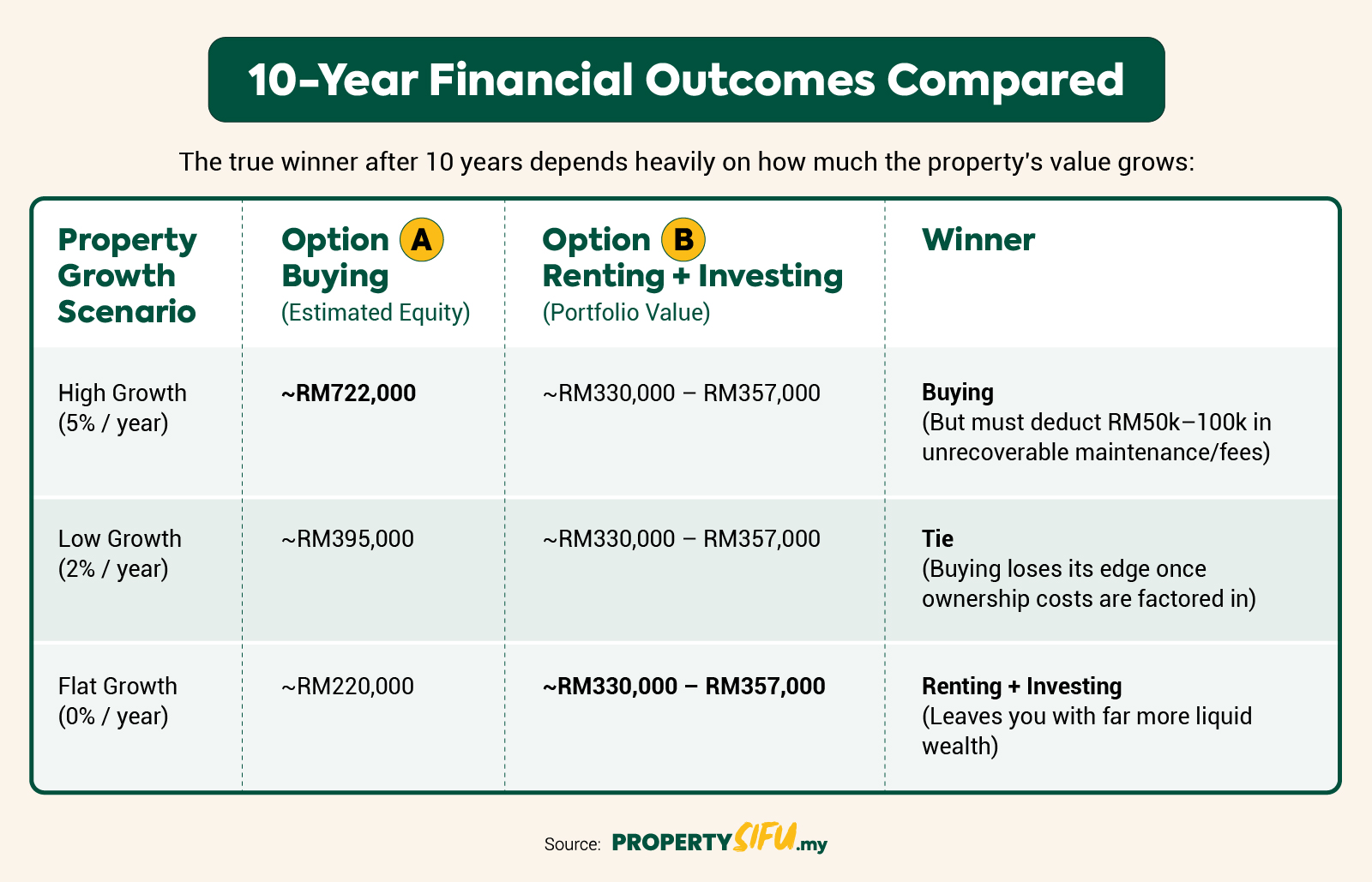
Based on the 5% annual property appreciation assumption, buying appears to create higher net worth.
Roughly:
Buying property equity: around RM722,000
Renting + investing portfolio: around RM330,000 - RM357,000
But here is the important part.
This result depends heavily on one assumption:
The property grows steadily at 5% per year.
If the property does not appreciate that much, the result can change completely.
What if the property only grows 2% per year?
A RM800,000 property after 10 years would be worth around:
RM975,000
After deducting the remaining loan of around RM580,000:
Estimated equity: around RM395,000
At this point, the gap between buying and renting + investing becomes much smaller.
If you also deduct maintenance fees, renovation, repairs, and transaction costs, buying may not look as strong as it first appeared.
What if the property price stays flat for 10 years?
Assume the property is still worth RM800,000 after 10 years.
After deducting the remaining loan balance of around RM580,000:
Estimated equity: around RM220,000
In this case, renting + investing with RM330,000 to RM357,000 may actually result in higher liquid assets.
So the real question is not:
“Is buying always better, or is renting always better?”
The real question is:
Will the property you buy have enough appreciation, rental demand, and resale demand over the next 10 years?
What are the real advantages of buying?
Buying a home is not only about winning mathematically.
It also gives you several important advantages.
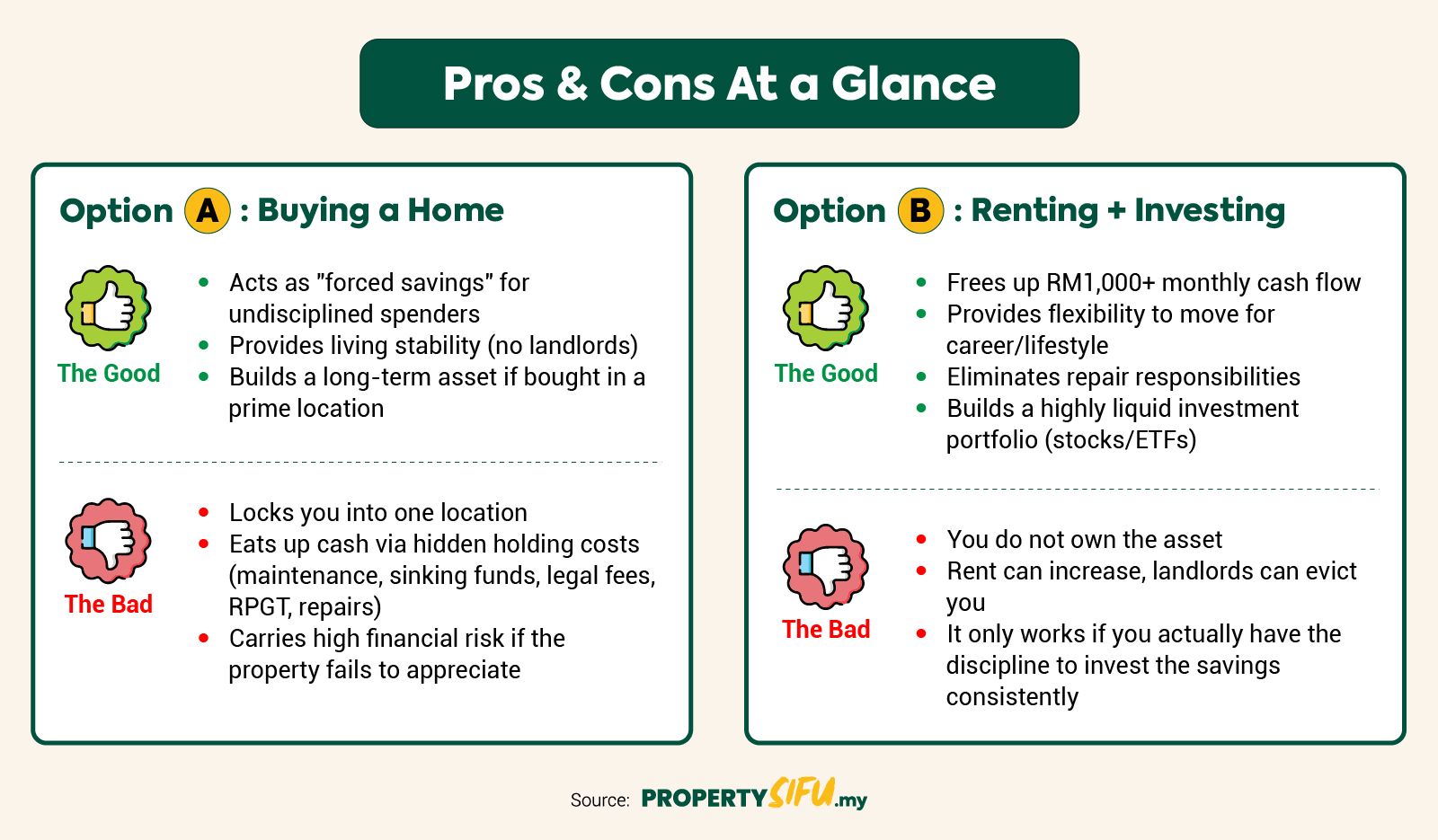
1. Forced savings
Many people say they will invest, but in reality, the money often gets spent.
A mortgage forces you to commit every month, which can help build long-term equity.
2. Living stability
You do not need to worry about the landlord taking back the unit, increasing rent sharply, or refusing to renew the tenancy.
For families, this stability can be very important.
3. Long-term asset building
If you buy the right property at the right price and in the right location, it can become a long-term asset.
4. Own stay and rental flexibility
A property can serve more than one purpose.
You can live in it now, and potentially rent it out or sell it later.
What are the real advantages of renting + investing?
Renting is not a failure.
For some people, it can be the more rational choice.
1. Lower monthly pressure
RM2,500 rent versus RM3,500 mortgage creates a very different level of monthly commitment.
The extra cash can be invested, saved, used for business, or used to improve your earning power.
2. More flexibility
Young professionals may change jobs, cities, income levels, or family plans.
Renting makes it easier to adjust your lifestyle.
3. Fewer hidden ownership costs
Buying a property comes with many extra costs:
Maintenance fee
Repairs
Renovation
Furniture and appliances
Tax-related costs
Management issues
Renters usually avoid many of these large expenses.
4. More liquid investment assets
Stocks, ETFs, unit trusts, or funds are usually easier to sell than a property.
Selling a property can take months, or sometimes longer.
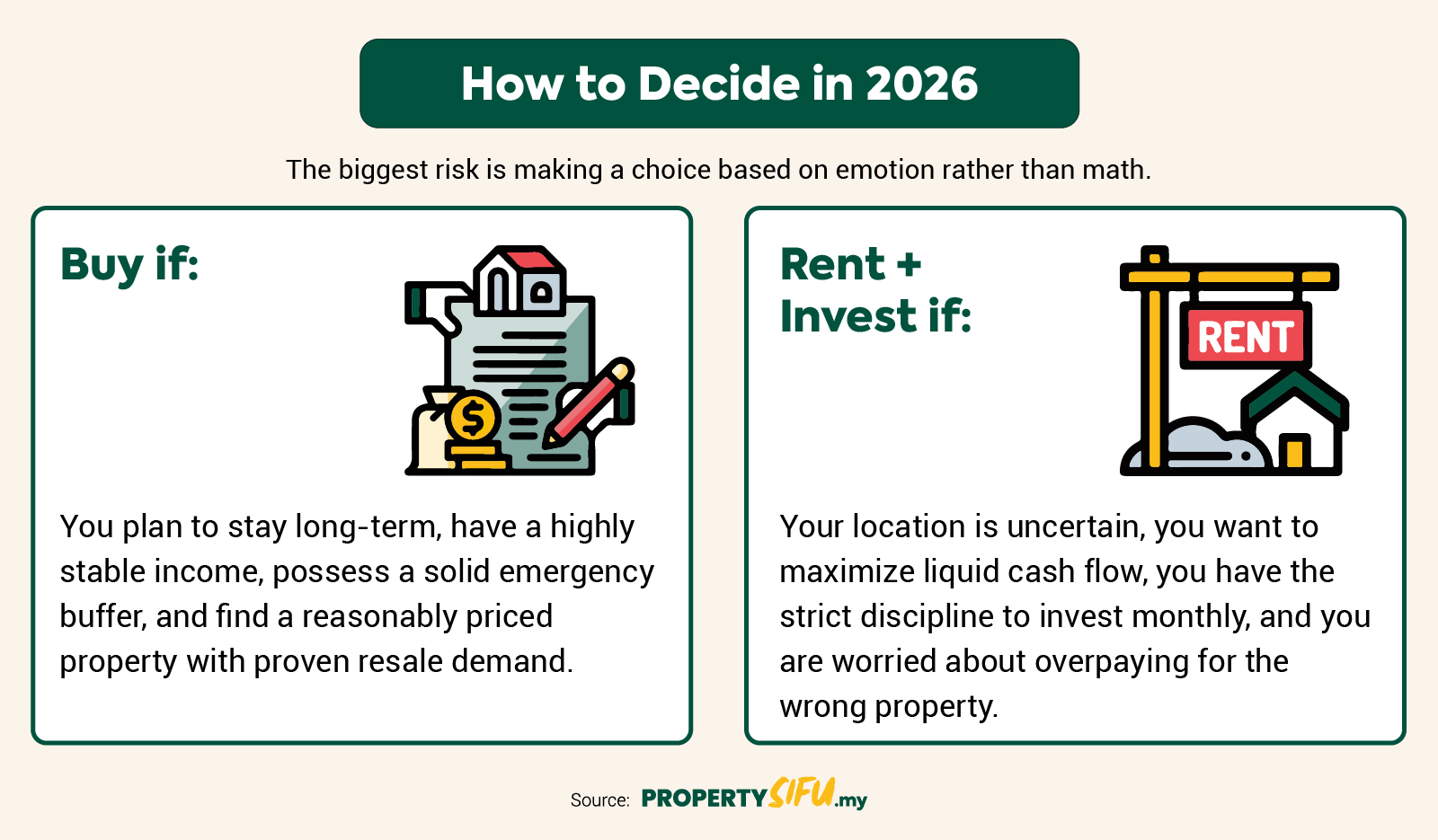
The biggest danger is not renting or buying
The biggest danger is:
Making the decision without doing the math.
Some people buy because they are afraid of falling behind.
Some people rent because they are afraid of commitment.
But a better decision starts with checking:
Your real monthly commitment
Your down payment and cash buffer
Whether the property appreciation assumption is realistic
The difference between rent and mortgage
Whether you can invest consistently
The property’s rental and resale demand
Whether you can handle interest rate changes
Whether you will regret the purchase if the property does not appreciate
How PropertySifu can help
Before buying, do not only ask:
“How much is this project?”
Ask instead:
“Will this property make my finances healthier after 10 years, or will it create more pressure?”
PropertySifu can help buyers review:
Monthly commitment
Buying vs renting cash flow
Whether the project price is reasonable
Layout, location, and maintenance fee
Rental and resale demand
Nearby alternative projects
Whether the property fits your budget and lifestyle
If you are thinking:
“Should I buy now, or continue renting?”
WhatsApp PropertySifu with your budget + preferred area.
We can help you run the numbers first, so you do not make the decision based on feeling alone.